- Compete on what homeowners notice: how fast you answer, whether you follow up, your recent reviews, and whether you show up in search.
- A May 2026 Census Bureau report found 37% of firms with at least 250 employees reported using AI, against less than 20% of firms with four or fewer employees.
- Fix the leads you already get and lose before you pay for more traffic.
- AI can't change your distance or buy you Maps rank. The FTC bans AI-generated fake reviews, and Google prohibits incentives for reviews.
- Set it up in order: answer every lead, then follow-up and review requests, then a chatbot and ongoing SEO, then ads.
On this page
Small businesses can use AI to compete with bigger contractors by matching them on what a homeowner actually notices: how fast you answer, whether you follow up, how many recent reviews you have, and whether you show up when they search. A shop with two trucks can now hand a lot of that office work to software. What software can’t do is move you closer to the customer or make the work any better.
That’s why the practical answer to how small businesses can use AI to compete starts with the leads you already get and then lose. For a lot of small shops, the leak happens after the lead arrives: the call you couldn’t take, or the form nobody saw until morning. Fix that before you pay for more traffic.
What the bigger company in town actually has
Think about the biggest roofing or HVAC company in your area. Many bigger shops have something you probably don’t: an office. At 4:55 p.m., somebody there still picks up the phone. Someone calls back the people who asked for a quote and went quiet, and someone texts a review link the day each job wraps up. None of that is hard. It just takes hours you’re spending on a roof or in a crawl space.

They’re also more likely to be using AI already. The US Census Bureau’s Business Trends and Outlook Survey asks businesses whether they used AI in any business function in the past two weeks. Its May 2026 report on AI use by firm size shows the gap:
Between December 2025 and May 2026, AI use rose among firms with at least 20 employees but didn’t change significantly among firms with fewer than 20. If you run a two-truck shop, you’re in the second group.
The homeowner never sees your headcount, though. They see whether anybody wrote back, and whether your reviews are recent and plentiful or few and old. That part you can match.
How small businesses can use AI to compete on the four things buyers notice
At a bigger company, each of these is somebody’s job. In a small shop, software can carry most of it. Most of that is plain automation, a rule that sends a text when something happens. AI comes in for website chatbots and for drafting replies.
Answer every call and form
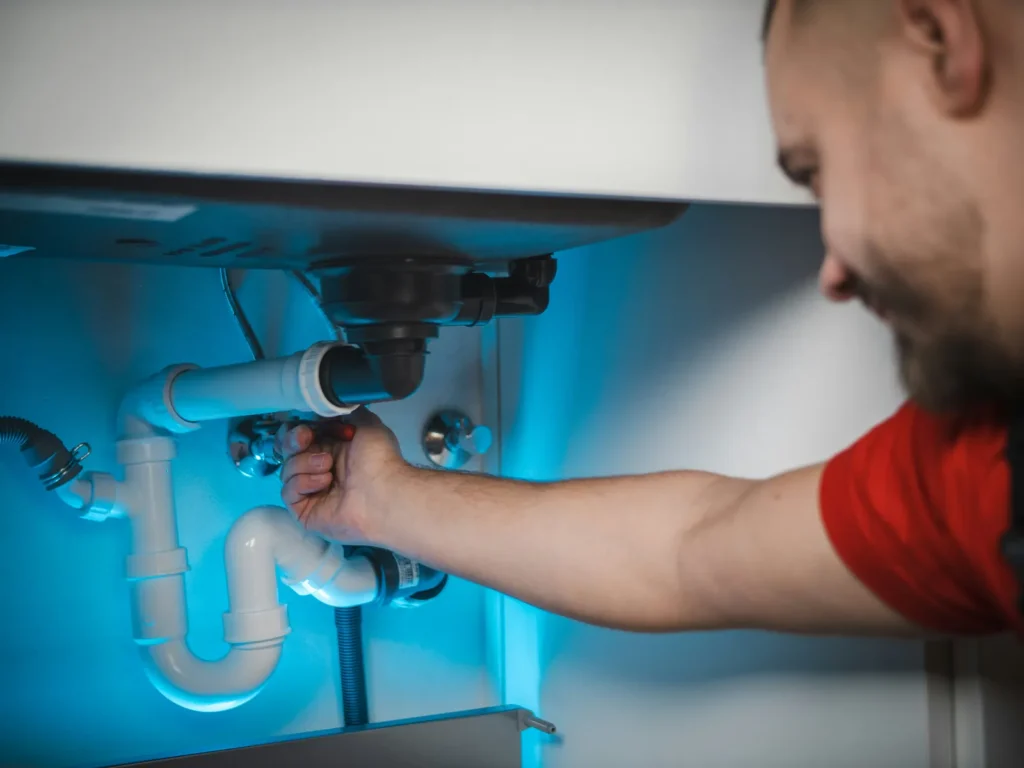
A plumber with both hands under a sink can’t take a call. Neither can a roofer on a steep pitch the morning after a storm. Missed-call text-back sends the caller a text right away, so they hear from you before they try the next name on the list. A web form gets an instant reply instead of sitting in an inbox, and a chat widget on your site catches the person who would rather type than call.
The text doesn’t replace calling back. It buys you time to finish the job. If you run Local Services Ads, Google gives you one more reason: its help page says that if you regularly fail to answer calls or respond to messages, your ad ranking may be affected (more on that in whether Google Guaranteed is still worth it). Missed-call text-back and form replies are part of our CRM and automation setup.
Follow up with the ones who didn’t book
Some people ask for a quote and go quiet. At the big shop, someone works that list. A few short texts and emails can go out on their own over the next several days, plus a reminder before each appointment. Still, put one person in charge of the callback. The automation keeps the lead warm. A human has the actual conversation.
Ask every customer for a review
Reviews pile up when somebody asks every single time, and software is good at remembering. When a job is marked done, the customer gets a text with your Google review link. Google’s help page suggests asking customers to visit a Google link or scan a QR code, so a QR code on the invoice works too.
Google says more reviews and positive ratings can help your local ranking, and that replying to reviews shows you value the feedback. Reply to the rough ones too, and keep it calm. Google also notes that a mix of positive and negative feedback often feels more trustworthy, so one bad review in a long list won’t sink you.
Show up when they search
When someone searches for an emergency plumber, Google says local results are mainly based on relevance, distance and how well-known a business is. You can’t change distance. You can work on the other two. Google says businesses with complete and accurate info are more likely to show up in local search results. In practice, fill in your hours, services, service area and photos, and keep them current. How well-known you are comes partly from your reviews and from how many websites link to you.
Then make sure the site they land on works on a phone, with your number one tap away. Our Smart Websites and local SEO pages show how we handle both. AI answer tools like ChatGPT are one more place a homeowner can find you, and that’s what AEO and AI search covers.
Find your biggest leak first
Trying all four at once is how a shop ends up paying for software nobody opens. Fix the one costing you the most jobs first. The quick check below asks six questions, starting with how fast you reply and ending with whether ChatGPT names you, then shows where leads are slipping away and what to fix. Your answers stay on your screen.
Find your lead leaks
Six quick questions about how leads reach you and what happens next. Your answers stay on your screen.
To make it concrete, take a made-up example (not a real client). A homeowner whose AC just quit sends the same web form to two shops at 8:47 p.m.
| Same form, 8:47 p.m. (example) | Shop A | Shop B |
|---|---|---|
| When the form comes in | It lands in an inbox nobody checks after 6 p.m. | A text goes out on its own asking for a good time to call |
| Later that night | Nothing. The homeowner fills out two more forms. | The homeowner texts back a time that works |
| Next morning | The owner calls at 10. They’ve already booked someone else. | The office calls at the time the homeowner picked |
| After the job | There’s no job, so there’s nothing to ask about | A review request with the Google link goes out on its own |
Both shops got the same lead on the same night. Shop B got the job, and software did most of the work of answering. If the form or site is the problem, why your website isn’t generating leads covers the usual causes.
What AI can’t do for a small shop
Most of these limits are practical. The first one carries legal risk.
Don’t let AI write your reviews, and don’t pay for them. The FTC’s final rule, announced in August 2024, bans fake reviews, including AI-generated reviews that claim to come from someone who doesn’t exist. It also bans incentives tied to a review expressing a particular sentiment. Google goes further: offering free or discounted goods or services in exchange for posting, changing or removing a review is strictly prohibited.
- Distance is out of your hands. It’s one of the main things Google weighs for local results, and no software changes where your shop sits.
- Maps rank isn’t for sale. Google says there’s no way to request or pay for a better local ranking. Ads are a separate, paid placement.
- Emergencies still need a person. A text can confirm you got the message about a burst pipe. Somebody still has to call, talk the homeowner through it and send a truck.
- Fast texts don’t fix a late crew. If the crew shows up two hours late or the flashing leaks, quick replies just get you a bad review sooner.
- Text only people who asked. That means people who reached out to you or agreed to hear from you, never a bought list.
- Automations break quietly. Someone edits a form field or swaps a phone number, and the text-back stops sending. Once a month, call your own number and fill out your own form.
- Someone reads it first. Have a person check every AI-written review reply, text and web page before it goes out. AI can get a trade detail wrong and sound completely sure about it.
What to set up first, and what it costs
Go in this order. Ads come last on purpose, because more leads only help once you answer and follow up on the ones you already get. Here’s where each step starts on NextVerra’s plans.
- Answer every lead. Missed-call text-back, a contact form, a chat widget, two-way calling, and SMS and email automations. This starts at VerraBasic, $197 a month.
- Follow up and ask for reviews. Advanced SMS and email follow-up, Google review requests that go out on their own, and a calendar booking system. These start at VerraUnlimited, $697 a month.
- Add an AI chatbot and ongoing SEO. An AI chatbot on your site, ongoing SEO updates and weekly blog content. These start at VerraPro, $997 a month.
- Turn on ads. Google and Meta Ads management, lead tracking and attribution, and a monthly ad report. That’s VerraElite, $1,997 a month. Ad spend is billed by Google and Meta, separate from the plan fee.
If your CRM or phone system already has text-back and auto-replies, you can set up the first step yourself. If you’d rather hand it off, every plan is on our pricing page, and how much digital marketing costs for contractors breaks down the three bills you’re actually paying and how to read a quote.
Is this right for you?
- Roofing, HVAC, plumbing and electrical shops with two to 10 people
- Owners losing jobs to a bigger competitor that has office staff
- Shops that get leads but miss calls or forget to follow up
- Companies with a full office team already answering and following up on every lead
- Anyone hoping to buy a higher Maps ranking or a stack of reviews
Frequently asked questions
How can a small business compete with larger businesses?
How can AI help a small home-service business?
How do I start using AI in a small business?
Do bigger companies really use more AI than small ones?
What should a small shop automate first?
Can I pay Google to rank higher on Maps?
Can I use AI to write reviews or give discounts for reviews?
Will automation replace my office person?
How much does it cost to automate this for a small shop?
How we know this
Outside numbers and claims on this page come from these sources. Each link opens the original so you can check it.
- US Census Bureau, America Counts: Large Firms With at Least 20 Employees Biggest AI Users
- Google Business Profile Help: Tips to improve your local ranking on Google
- Google Business Profile Help: Tips to get more reviews
- Google Local Services Help: Getting started with Local Services Ads
- FTC press release: Federal Trade Commission Announces Final Rule Banning Fake Reviews and Testimonials

NextVerra is a Huntsville, Alabama marketing agency for home-service businesses. We build websites and run SEO, AI search (AEO), ads, and CRM automation. About us · How we write our guides